
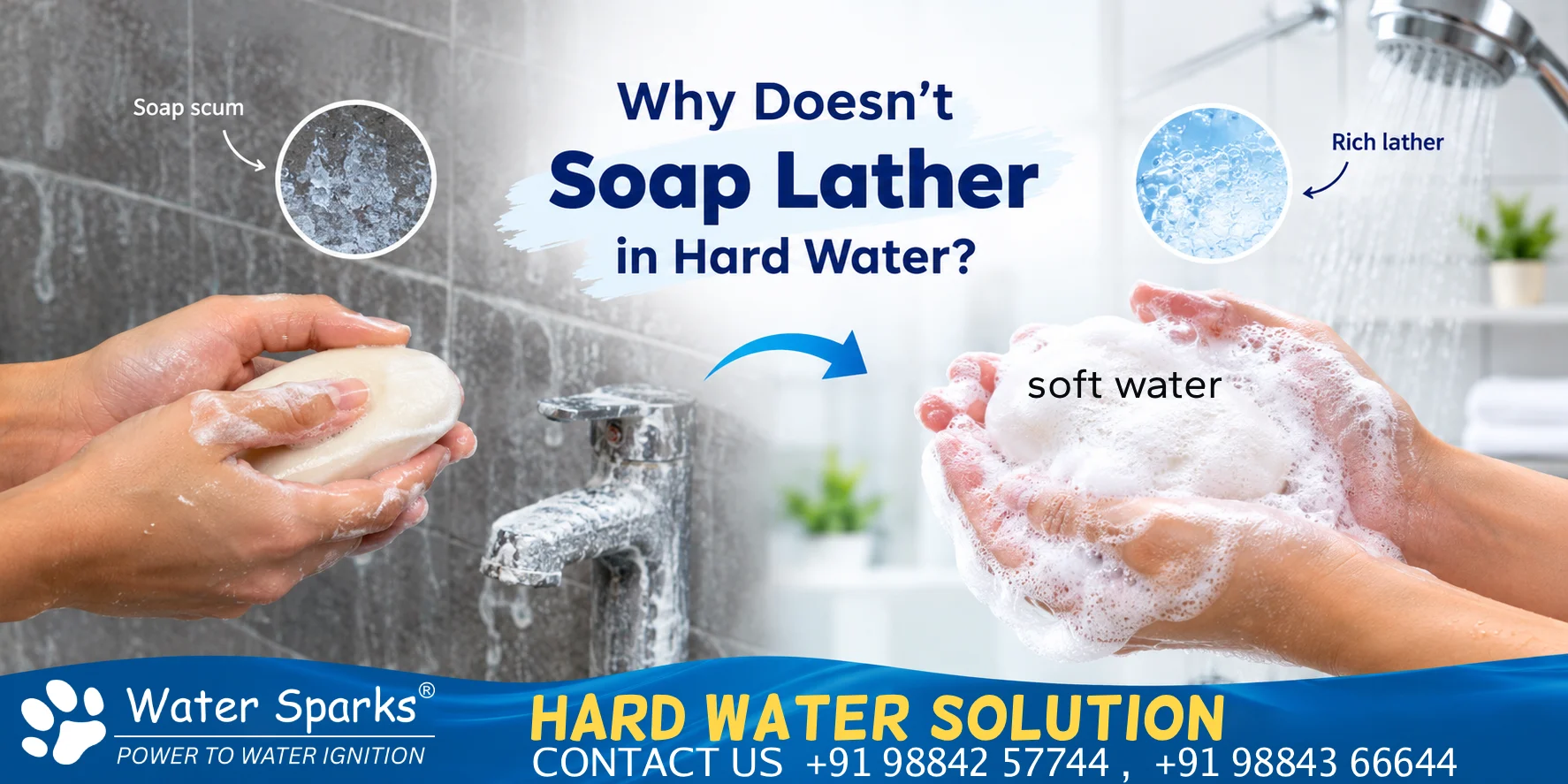
Why Soap does not lathering in hard water?
As a Chennai resident, there must be one occurrence, and one very specific question that often comes up on your mind- “Why soap does not lathering in hard water?” That’s why WaterSparks is here to shed some light on that, and offer a real, workable and permanent solution!
Soap doesn’t lather in hard water because calcium and magnesium in water react directly with the soap molecules and form sticky scum or tiny white precipitates- instead of the rich foam one would typically expect. When these dissolved minerals are present in high concentrations, your soap, body wash, and shampoo are continuously wasted.
While BIS standards set the limit for water hardness at 200 ppm, it is likely that your home’s water supply exceeds the same. In fact, data from the Central Ground Water Board (CGWB) indicates that groundwater in many residential pockets of Chennai frequently scales up past 500 ppm to 1,000 ppm. Installing a whole house water softener removes these minerals right at the point of entry, ensuring that soap and shampoo lather normally again across your entire home.
Soap Does Not Lathering in Hard Water: What Causes It?
If you constantly observe soap not lathering in hard water,don’t rush to blame the detergent! In truth, the primary culprit is the underlying mineral content present in the water, or at its source. Hard water carries elevated levels of dissolved calcium and magnesium in water. When you wash your hands, take a shower, or do laundry, the fatty acids inside standard soap (such as oleic acid and palmitic acid) react instantly with these dissolved minerals.
Instead of dissolving in water to create foam and cleansing bubbles, the soap molecules take a sideways route- and bind directly to the minerals, forming what is colloquially known as lime soap. Because a massive portion of the soap gets consumed by this chemical reaction, you end up using significantly more soap while getting much less foam. This issue of soap not lathering in hard water is a daily frustration for millions of households across India, particularly coastal and geographically mineral rich areas like Tamil Nadu which are reliant on borewell water.
How Do Calcium and Magnesium in Water Block Lather?
To address this question, let us take a trip down memory lane and revisit tenth standard chemistry! At a molecular level, traditional soap is made of sodium or potassium salts derived from fatty acids, through a chemical process known as saponification.
Under normal circumstances, these salts dissolve freely in soft water, lowering surface tension and forming rich, soapy bubbles. However, when calcium and magnesium ions are present, they swap places with the sodium ions in the soap.
This reaction produces calcium and magnesium stearate- insoluble salts that completely refuse to dissolve in water. Instead of generating lather, these insoluble compounds precipitate out of the liquid as a thick, sticky white layer. This is why you experience soap not lathering in hard water, no matter how much soap you scrub onto your skin.
What Is Hard Water Soap Scum?
Hard water soap scum is the unsightly, sensory nightmare of white or grey film that forms on bathroom tiles, plastic buckets, stainless steel taps, and glass shower doors when soap reacts with hard water minerals. Because the insoluble calcium and magnesium stearate compounds cannot be rinsed away cleanly by water, they cling aggressively to every surface they touch.
This layer of hard water soap scum is annoyingly difficult to clean and repeatedly builds up- even with regular household scrubbing. Over time, it dulls bathroom surfaces, chokes showerhead nozzles, and leaves a thin, sticky residue on your skin and hair that can cause persistent dryness and irritation.
How Does a Whole House Water Softener Restore Soap Lather?
A whole house water softener eliminates the root cause of hard water by physically removing those pesky problem minerals before the water enters your home’s distribution network. By treating the water at the point of entry, it ensures that soft, mineral-free water reaches every bathroom, kitchen tap, and washing machine line in your house.
Once these hardness minerals are stripped out, your soaps, shampoos, and detergents can function as intended. They dissolve smoothly, produce rich lather instantly, and rinse away completely without leaving behind any sticky film or residue.
What Is Ion Exchange?
Water softeners rely on a chemical process known as ion exchange. In this process, water entering the softener tank passes through a bed filled with millions of microscopic resin beads that hold a negative charge and are coated with sodium ions.
As raw groundwater flows through the resin, the positively charged calcium and magnesium ions are attracted to the resin beads and trapped. In exchange, harmless sodium ions are released into the water stream. Over time, once the resin bed becomes saturated with trapped minerals, the system automatically recharges itself using a salt brine solution to restore its softening capacity.
Frequently Asked Questions
Why do I need more shampoo in hard water?
In hard water, a large portion of your shampoo is immediately neutralised by dissolved calcium and magnesium ions before it can foam up. To overcome this chemical reaction and achieve a cleansing lather, you end up using way more than your usual amount of shampoo!
What other hard water problems at home should I look out for?
Common hard water problems at home include heavy limescale scaling inside geysers and kettles, stiff and faded laundry, reduced water pressure due to clogged pipes, dry skin, severe hair fall, and frequent breakdown of home appliances like washing machines.
How do I know if my water is hard?
You can identify hard water through clear visual signs around your household, such as persistent white scale buildup on tap spouts, sticky soap scum on buckets and shower walls, stiff or scratchy clothes after washing, and constant difficulty getting soap to foam.
Will a water softener make soap feel slippery?
Yes. And that’s not the red flag you think it is at all! Bar soap, especially, is meant to feel slippery when handled with good quality softened water. When you wash with such water, soap produces a rich, creamy lather (like the ones we see in advertisements!) and also washes clean off of your skin, without any unwanted hassle or residue.
Get a Free Quote for a Whole House Water Softener in Chennai
Tired of endless soap scum, dull hair, and stubborn limescale destroying your bathroom fittings? You don’t have to live with hard water damage anymore. At WaterSparks, we design custom, heavy-duty water softening systems calibrated specifically to handle Chennai’s high groundwater hardness levels.
Protect your home’s plumbing, prolong the life of your appliances, and enjoy luxurious, soft water at every tap- and aligned with BIS standards!
Contact WaterSparks and take the first step toward soft, better quality water today!