
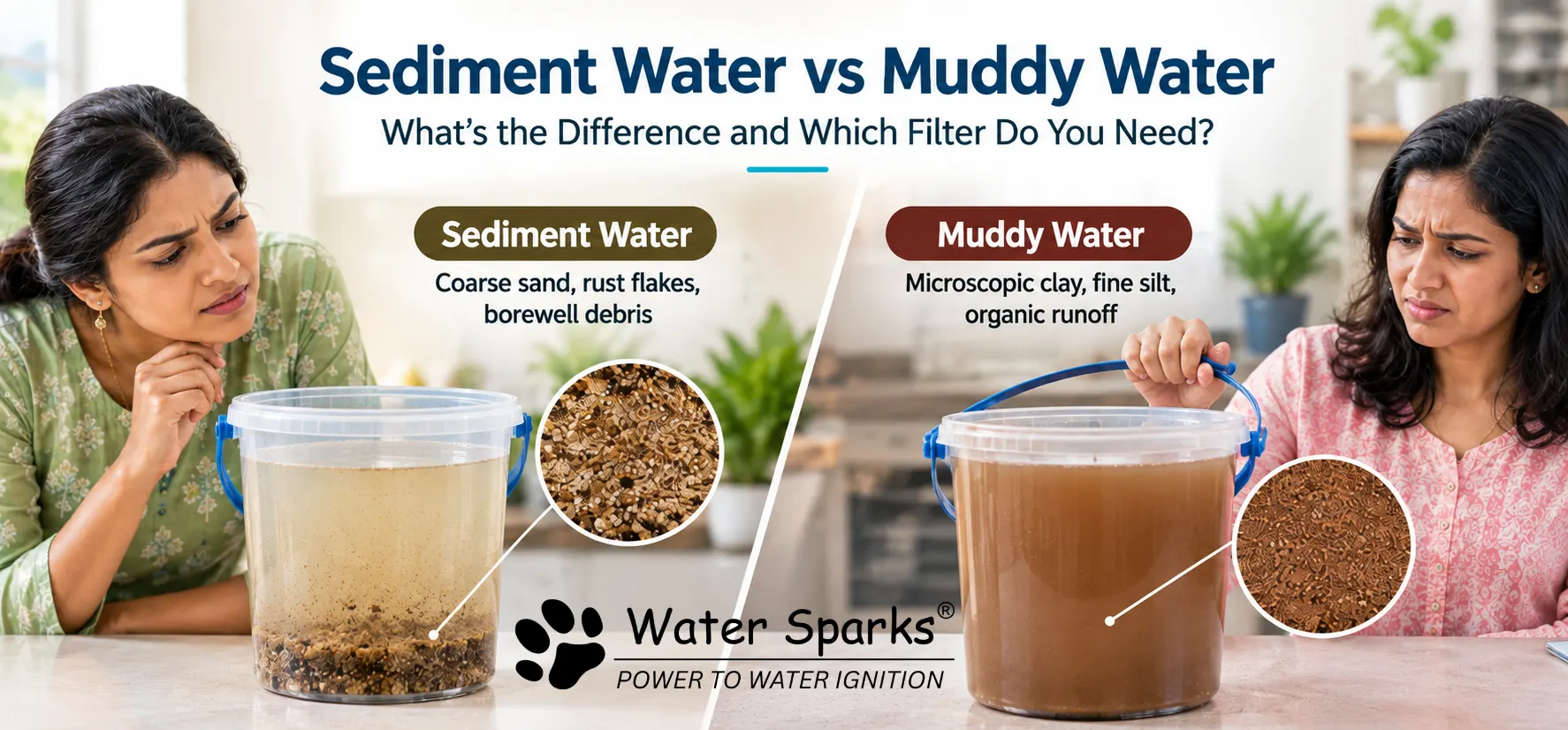
Sediment Water vs Muddy Water: What's the Difference and Which Filter Do You Need?
Have you ever returned from a sweltering Chennai summer day looking forward to a cool bath- only to turn the tap and get…..wait- why does that look like watered down tea?
Whether you’re a resident of OMR, Velachery or Nungambakkam- dealing with a dodgy water supply is a rite of passage. And so is hunting for a viable solution. Before you make a decision- here’s an eye opener.
As for the mystery liquid coming from your tap- it’s sediment water vs muddy water. And what looks like the exact same problem on the surface, is in reality, completely different scientific headaches. Treat sediment like mud, and you’ll choke your filters in three days flat. Treat mud like sediment, and dirty water will sail right past your systems into your overhead tank. Let’s break down the science of what’s happening in your pipes- and see how WaterSparks engineers the exact fix you need.
Sediment Water vs Muddy Water: How to Tell the Difference
Before we dive into concepts, let’s run a quick science experiment right in your Chennai home kitchen. Grab a clear glass, fill it up from your tap, set it on the counter, and step away for a bit.
The Sediment Scenario: If you come back in 15 minutes and see heavy particles resting at the bottom like coarse beach sand while the water above looks crystal clear, you’re dealing with sediment.
The Muddy Scenario: If the water remains uniformly brown, murky, and suspended like it was initially, you’ve got muddy water on your hands.
This quick glass test is the ultimate shortcut in the sediment water vs muddy water puzzle- a knowing which one you have stops you from buying an overhyped and misdirected filter that will give you no respite from the issue.
What is Sediment Water and How Do You Treat It?
Let’s look at the first culprit: sediment. In the world of water physics, sediment consists of larger, heavier physical particles- like coarse sand from deep borewell drilling, flakes of rust peeling off aging municipal pipes, or tiny bits of rock. Those scratchy particles when washing your face, or the inexplicable gritty water in taps?- definitely sediment.
Sediment particles are primarily trumped by gravity. Because they are relatively large and heavy, they sink quickly. However, as they travel through your plumbing at high pressure, they act like micro-sandblasters. They slice up rubber washer seals, clog shower aerators, and build up inside your geysers until they break down.
How a Sediment Filtration System Protects Your Home
Because sediment is made of large, physical debris, solving it doesn’t require complex chemistry- just smart mechanical engineering! A high-efficiency sediment filtration system from WaterSparks acts like an ultra-precise bouncer for your home’s water pipelines.
Using specialized fully automatic Dual media filters with Water Sparks Bag Filters or Water Sparks Stainless-steel mesh Filter rated down to microscopic sizes, these filters catch sand and rust flakes on the outside while letting pure water glide through. It’s an effortless, high-flow fix that keeps your plumbing safe and stops physical grit cold.
What is Muddy Water and How Do You Fix It?
If water supplies had a resident villain, it would have to be the ever-prevalent muddy water in Indian sources (or that classic semman water that arrives right after the monsoon!). Unlike heavy sand, muddy water is packed with microscopic clay, fine silt, and organic soil runoff. Here’s a fun science fact: these tiny clay particles actually carry a negative electrostatic charge! Because like charges repel each other, the clay particles constantly push away from one another, refusing to clump together or sink to the bottom of your underground sump. Fascinating in theory….but an absolute nightmare for daily life.
These charges create a persistent, cloudy haze that won’t clear up on its own. This fine silt stains your white clothes, leaves stubborn orange rings in your toilet, and coats your overhead tank with thick sludge. If you’re on your search for a reliable cloudy water filter setup- look no further!
Why Muddy Water Requires a Specialized Filtration Approach
Here is why most off-the-shelf filters fail miserably against Chennai mud: if you use a simple mesh filter, the microscopic clay slips right through the holes. But if you try to stop it using a super-tight paper filter, the sticky silt completely glazes over the surface, choking your home’s water pressure to a slow trickle within hours- annoying, right? That is why choosing the right cloudy water filter mechanism is crucial for long-term clarity.
Role of Heavy-Duty Ultrafiltration
To tackle colloidal clay without sacrificing your water pressure, you need precise ultrafiltration. Enter the ultimate precise ultrafiltration: WaterSparks’ Muddy Water Buster!.
Instead of forcing water through a thin paper sheet, our engineered systems pass water through deep beds of graded quartz sand, media, and anthracite. The micro-silt gets trapped deep within the matrix layers. Paired with automated backwashing that flushes the trapped mud down the drain, your overhead tank stays sparkling clean with zero daily effort on your part.
Let’s Evaluate: Choosing the Right Filter for Your Home
Still trying to weigh your options? Here is a handy recap matrix comparing sediment water vs muddy water side-by-side so you can pick your winning filter setup at a glance:
Parameter | Sediment Water | Muddy Water |
The Contaminant | Coarse sand, rust flakes, borewell debris | Microscopic clay, fine silt, organic runoff |
The Physics | Heavy particles that sink quickly | Electrically charged particles that stay floating |
What You See & Feel | Gritty water in taps, scratchy sand | Persistent brown haze, stained porcelain |
How It Ruins Your Day | Sandblasters your valves & geyser seals | Coats your overhead tank in thick brown sludge |
The WaterSparks Solution | Automatic High-flow sediment filtration system | Muddy Water Buster – A precise Ultrafiltration Solution |
Key Takeaway for Homeowners
If your water impurities sink like a rock in a glass, a mechanical sediment filter will do the trick effortlessly. But if the cloudiness stays suspended like a fog, let WaterSparks install a deep multi-grade media filter to enjoy clean, clear water across your entire home!
FAQs
What is the difference between sediment water and muddy water?
Sediment water contains visible, heavier particles such as sand, rust flakes, and borewell debris that tend to settle at the bottom. Muddy water contains much finer clay and silt particles that remain suspended, making the water look continuously brown or cloudy. Because the impurities are different, the required filtration system is also different.
How can I tell if my home has sediment water or muddy water?
A simple way to identify the problem is to observe the water after it has been collected in a bucket or transparent container. If heavier particles settle at the bottom while the upper water becomes clearer, it is more likely to be sediment. If the water remains uniformly brown or cloudy, it may be muddy water containing fine silt or clay.
What filter is best for sediment water?
A sediment filtration system is generally suitable for water containing sand, rust flakes, and other larger physical particles. Depending on the water quality and flow requirement, WaterSparks can use stainless-steel mesh, bag filtration, or automatic multi-media filtration to reduce sediment entering household plumbing.
What is the best filter for muddy water?
Muddy water containing very fine silt and clay may require a specialized filtration approach rather than a basic mesh filter. A Muddy Water Buster using appropriate ultrafiltration or multi-stage media filtration can be considered based on the severity and characteristics of the muddy water.
Can a sediment filter remove muddy or cloudy water?
A basic sediment filter may remove larger suspended particles, but it may not effectively handle very fine clay and colloidal particles responsible for persistent muddy or cloudy water. If the water stays brown or cloudy, a more suitable cloudy water filter or specialized filtration system may be required.
Why is there gritty water coming from my taps?
Gritty water in taps is commonly associated with physical particles such as sand, rust flakes, or other sediment entering the plumbing system. These particles can collect in taps, shower outlets, valves, and appliances. A properly selected sediment filtration system can help reduce this physical debris before it reaches the household plumbing.