
Installing an Automatic Iron Removal Plant with Chlorine Dosing in Virugambakkam
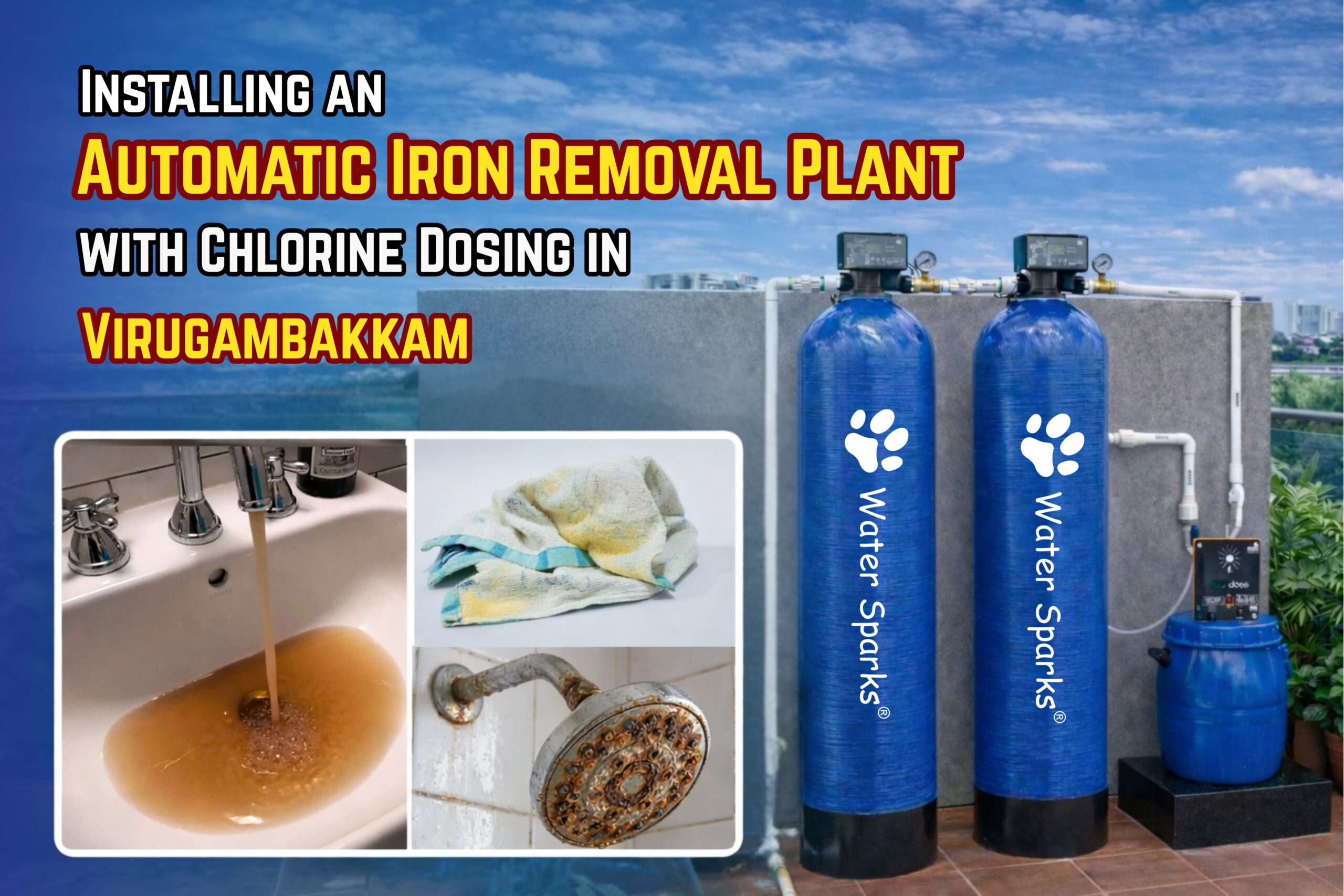
Installing an automatic iron removal plant with chlorine dosing in Virugambakkam, Chennai, is like giving a home’s water system a superhero upgrade. In this case, the project was for an individual house where the owner had been struggling with a persistent brown water problem coming from the taps. What looked like clear water at first would soon turn rusty, staining sinks and clothes and leaving a metallic odour behind, much like rust slowly spreading across metal.
While searching online for a reliable solution, the homeowner found WaterSparks® on Google and was impressed by positive reviews from other customers in Chennai. After we were contacted, our team recommended an automatic iron removal plant with a chlorine dosing pump. Just as a sieve filters unwanted particles from flour, this system removes iron, rust, and hidden sediments while the chlorine dosing pump acts as a vigilant guardian against microbes. The installation transformed the home’s overhead tank supply into a source of clean and clear water for everyday household use.
Why Iron and Contaminants Are a Problem in Virugambakkam, Chennai
In Virugambakkam, Chennai, the homeowner contacted us after repeatedly noticing brown water from the taps. The water appeared clear at first, but later turned brown or orange, leaving stains on sinks, utensils, and laundry. Since we never recommend a treatment solution without identifying the exact cause, our team advised the homeowner to first conduct a proper water test. We always rely on water test reports before reaching any conclusion, as they identify the actual contaminants present in the supply. [1]
In many parts of Virugambakkam, such issues are often linked to borewell water from underground sources. As groundwater passes through iron-rich soil and rocks, dissolved iron mixes with the water. When this water is stored in overhead tanks and exposed to oxygen, the iron oxidizes, turning the water brown or orange and leaving yellow stains on sinks and laundry. Sediments and microbes may also enter during storage, further affecting the water’s quality and appearance.
Identifying the Root Cause of the Brown Water Problem
At this site in Virugambakkam, Chennai, the main water source was borewell water, which often contains dissolved iron because groundwater passes through iron-rich soil and rock layers underground. Although the water may appear clear when first pumped, it can later turn brown or orange when exposed to air, causing yellow stains on sinks, toilets, and laundry.
To identify the exact cause, we advised the homeowner to collect a water sample directly from the borewell outlet before it entered the overhead tank. The sample was sent to a certified laboratory for testing and also shared with our team so our water experts could examine it. This allowed us to assess water turbidity and observe how quickly the iron settled.
The water test report revealed extremely high iron levels of 12.80 ppm, far above normal household levels. This explained the severe brown water problem, rust-like discolouration, and staining in the house. The report also showed the presence of microbial organisms, commonly known as iron bacteria, which are often found in iron-rich borewell water.
Understanding the Impact of High Iron in This Case
High iron levels and microbial contamination can gradually damage household pipes, appliances, and water systems. In this Virugambakkam case, the water test showed iron levels of 12.80 ppm, which is extremely high for household water. At this level, the water easily turns brown or orange when exposed to air, causing heavy stains on sinks, faucets, tiles, and laundry, along with a noticeable metallic odour. [2]
Such high iron content can also cause buildup inside pipes, geysers, and washing machines, reducing their efficiency over time. Iron-rich conditions also support the growth of microbes and iron bacteria, further degrading water quality. Together, these problems turn normal household water into a persistent issue, making daily activities like washing, bathing, and cleaning more difficult while slowly damaging plumbing fixtures and appliances.
How Iron Affects Pipes, Appliances, and Water Quality
Pipes – High iron in water slowly builds up inside pipes, just like rust forming on metal. Over time, this buildup can reduce water flow and may even cause corrosion or leaks.
Appliances – Washing machines, geysers, and dishwashers have to work harder when water contains iron. Iron deposits can accumulate inside the machines and reduce their efficiency over time.
Laundry and Fixtures – Iron in water often leaves orange or reddish stains on clothes, sinks, toilets, and taps. These stains can be difficult to remove even after repeated cleaning.
Water Odor and Clarity – Water with iron may sometimes look clear, but it can develop an unpleasant metallic or musty odor and may also appear slightly cloudy. This can make the water uncomfortable to use for daily household activities.
Health Impact – Small amounts of iron are usually not harmful, but when iron levels are elevated and combined with microbes, they can affect the quality of the household water.
Signs That Your Water Needs Treatment
Discoloured Water – If the water coming from your taps turns orange or Brown water problem, it is a clear sign that iron or sediments are present in the water.
Stains on Laundry and Fixtures – yellow stains on sinks, clothes, and toilets are a common sign of iron in the water and can be difficult to remove.
Cloudy or Murky Appearance – If the water looks cloudy or dirty, it may contain sediments or iron particles.
Unpleasant Odor – A strange metallic or musty smell in the water may indicate the presence of bacteria or other contamination.
Appliance Damage – High-iron water can slowly damage appliances such as geysers, washing machines, and dishwashers, reducing their efficiency and lifespan.
Testing Key Parameters at the Site
Iron – Water testing at the Virugambakkam site showed iron levels of 12.80 ppm, which explains the severe brown water problem, rust-coloured stains on fixtures, and discolouration seen in laundry and sinks.
Magnesium – The water analysis also showed magnesium levels of 25.0 mg/L, which can contribute to mineral deposits in plumbing systems and appliances over time.
Manganese – Iron-rich groundwater often contains manganese, which can create dark brown or yellow stains on sinks, tiles, and clothes.
pH Level – The pH of water affects how iron reacts, as very acidic or alkaline water can increase corrosion and iron deposits in pipes.
Turbidity – Water testing also showed very high turbidity of 58.0 NTU, indicating a large presence of suspended solids such as sand, silt, and oxidized iron particles in the supply. This level of turbidity accounts for the cloudy appearance and the heavy sediment observed in the untreated water.
Dissolved Oxygen – Oxygen in water converts ferrous iron (Fe²⁺) into ferric iron (Fe³⁺), which forms rust-like particles and discolours the water.
Microbial Presence – Iron bacteria can grow in iron-rich water, forming slimy deposits in tanks and pipelines that affect water flow and quality.
Regular Water Testing – Periodic water testing helps monitor these parameters and detect iron-related problems early.
Automatic Iron Removal Plant with Chlorine Dosing
After reviewing the water test report, our team contacted the homeowner to explain the findings. The report showed very high iron levels of 12.80 ppm along with high turbidity, which explained the persistent brown water and staining in the house. Based on this, we recommended installing an automatic iron removal plant with a chlorine dosing pump to treat the water before it reached the overhead tank and taps.
In this system, chlorine is first added through a dosing pump, which converts dissolved iron into small solid particles. This step is important because dissolved iron cannot be removed unless it becomes filterable. The water then passes through the iron removal plant, where these particles are trapped and removed. This process prevents brown water, stains, and pipe buildup, while chlorine also helps control bacteria and other microbes, resulting in clearer water for daily household use.

Results You Can Expect After Installation
After installing the automatic iron removal plant with chlorine dosing, the improvement in water quality was immediately noticeable. Water from every tap became clear, free from the brown or orange discolouration the homeowner had been experiencing. With the high iron levels removed, the metallic odour disappeared, and the water no longer left stains on sinks, taps, or laundry. The chlorine dosing pump also helped control microbes, keeping the overhead tank water cleaner. [3]
The homeowner also noticed improvements in daily use. Clothes washed without yellow or rust stains, and fixtures like sinks and taps stayed cleaner. Appliances such as geysers, washing machines, and dishwashers were better protected from iron buildup. Overall, the customer was very satisfied as the brown water problem was resolved and the home’s water system worked smoothly again.
Why Choose WaterSparks® for Customized Whole House Water Treatment in Chennai
In Virugambakkam or Nearby Areas? If you are facing brown water, iron stains, or water quality issues, our WaterSparks® experts are ready to help with the right solution for your home.
Proper Testing & Tailored Solutions – We first review your water test report and then recommend a customized system that suits your water source and household needs.
Advanced Systems & Expert Installation – Our automatic iron removal plants with chlorine dosing pump are installed by skilled technicians to effectively remove iron, sediments, and microbes.
Reliable Local Support – If you are in Virugambakkam or neighbouring localities, simply call our WaterSparks® water experts for professional guidance and installation.