
Whole House RO Plant + pH Neutralizer for Salt Water Problem in Chennai
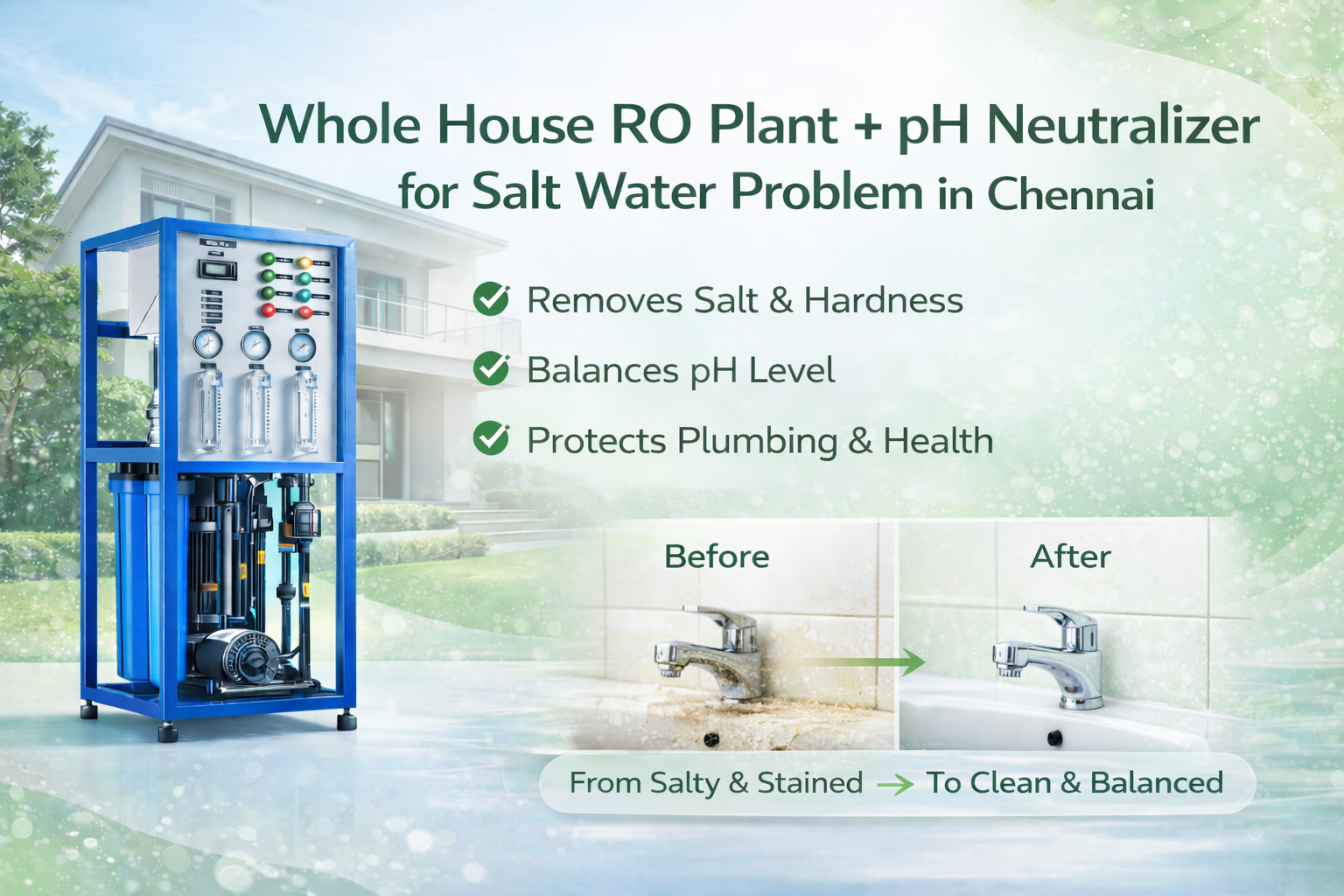
In many parts of Chennai, water doesn’t just flow; it tells a story. Sometimes, that story tastes salty, leaves white stains behind, and silently damages plumbing like slow rust eating away at iron. This was exactly the situation faced by a homeowner in Thiruverkadu, Chennai, where the water had a TDS level of more than 2000 ppm.
When water is overloaded with dissolved salts, it may appear clear but carries an excessive mineral load that affects taste, plumbing, and health. The solution? A Whole House RO Plant in Chennai, combined with a pH Neutralizer, is specifically designed to tackle high TDS levels and balance acidic water effectively.
Why High TDS and Saltwater Issues Are Common in Chennai
Chennai’s geography and heavy dependence on borewell water significantly contribute to its water quality challenges. Excessive groundwater extraction gradually increases mineral-rich water concentration in freshwater aquifers, resulting in high TDS levels (Total Dissolved Solids), particularly in borewell sources. In areas such as Thiruverkadu, TDS levels often cross 2000 ppm, far above the safe limit for drinking water. As TDS rises, water becomes salty, leaves white stains on tiles and cars, and forms scale inside pipes and appliances.
High TDS and mineral-rich water are major concerns across Chennai. During summer, when groundwater use increases, TDS levels often exceed safe limits. In areas such as Sholinganallur, Medavakkam, Pallikaranai, Perumbakkam, Thiruverkadu, Porur, Injambakkam, ECR, and parts of Tambaram, TDS commonly ranges from 1500 to 2500 ppm.
This mineral-rich water not only affects taste but also causes scaling in plumbing systems, damages appliances, and makes water unsuitable for drinking without proper treatment. In addition to high TDS levels, many homes also face hard water, iron stains, and pH imbalance, which, over time, affect plumbing, skin health, and overall household comfort.
Major Water Sources Supply in Thiruverkadu, Chennai
Drawn from underground aquifers, borewell water is the main and most dependable water source for many homes and institutions, especially in areas where municipal supply is limited or inconsistent. Since the entire household, including drinking, cooking, bathing, cleaning, and overhead tank storage, relies heavily on borewell supply, the overall water quality directly impacts daily life.
Over time, continuous groundwater extraction lowers the water table. As deeper layers are tapped, the concentration of dissolved salts and minerals naturally increases. This is one of the key reasons borewell water often shows high TDS, elevated Mineral-rich water, and significant hardness. In several areas, excessive pumping further concentrates these dissolved solids, pushing TDS levels well above safe limits. [2]
As a result, borewell water may taste salty, leave white stains on tiles and fixtures, and cause heavy scale buildup inside pipes, taps, heaters, and appliances. In some cases, iron content and pH imbalance add to the problem. Without proper water testing and treatment, these hidden issues can gradually damage plumbing systems, shorten appliance lifespan, and compromise overall water safety and household comfort.
Impact of High TDS and Acidic Water on Homes & Plumbing
High TDS levels of water behave like a silent troublemaker inside a home. It leaves stubborn white salt deposits on taps, dulls bathroom fixtures, and forms thick scale inside pipes and geysers, slowly choking water flow. Washing machines and dishwashers lose efficiency, heaters consume more electricity, and appliances wear out faster than expected. Clothes may feel stiff after washing, and glassware turns cloudy over time. From a health perspective, very high TDS water often tastes salty or bitter and may cause digestive discomfort in some individuals, especially children and elderly people, if consumed regularly without treatment.
The bigger concern arises when pH drops. In the Thiruverkadu case, the raw water had a pH of 6.5, already at the lower limit of the safe drinking range (6.5 to 8.5). After installing a Whole House RO Plant, although TDS was significantly reduced, the pH fell further to 5.8, making the water acidic. Acidic water is like lemon juice flowing through pipes, corrosive and reactive. It can gradually damage plumbing, cause metal leaching from pipelines, and alter the taste of drinking water. Though mildly acidic water may feel soft on the skin during bathing, it is not safe for regular consumption and can irritate the digestive system over time if left uncorrected. [3]
Essential Water Parameters to Check Before Choosing a Treatment System
Before installing any system, laboratory testing is crucial. Important parameters include:
- TDS (Total Dissolved Solids) – Measures the total amount of dissolved salts and minerals in water, mainly caused by groundwater salinity, saltwater intrusion, and mineral-rich soil.
- pH Level – Indicates whether water is acidic or alkaline, often affected by dissolved minerals, industrial influence, or underground chemical reactions.
- Hardness – Shows the presence of calcium and magnesium, typically caused by water passing through limestone and mineral-rich rocks.
- Chloride Levels – Reflects salt content in water, commonly increased due to seawater intrusion or contaminated groundwater sources.
- Sulphates – Naturally occurring minerals that dissolve from soil and rocks; high levels may affect taste and cause mild digestive discomfort.
Testing water first is like diagnosing a patient before prescribing medicine; without proper analysis, the wrong treatment system may create new problems while trying to fix existing ones.
When Should You Conduct a Water Quality Test in Chennai?
Water testing should not be an afterthought. It should be the first step. If your home depends on a borewell or mixed water sources, annual testing is highly recommended. In Chennai, where water quality can shift seasonally, testing becomes even more important after heavy rains or prolonged dry periods.
Signs That Indicate It’s Time to Test Your Water in Chennai
- Salty taste in drinking water
- White stains on cars, tiles, and glass
- Frequent plumbing corrosion
- Soap is not lathering properly
- Metallic taste or mild sourness
If water tastes unusual or leaves visible marks, it is already sending warning signals.
Final Outcome: Balanced pH, Reduced TDS & Satisfied Customer
In this Thiruverkadu project, the solution was carefully customized based on the lab test results. First, a Whole House RO Plant was installed to reduce the extremely high TDS levels and remove excess salts from the water. This made the water much lighter, less salty, and safer for household use. However, because the pH dropped after RO treatment, a pH Neutralizer was added to restore the water to a safe, balanced level for drinking. Additionally, a sediment filter was installed to prevent dirt, rust, and small particles from entering the drinking water pipeline. [3]
The final result was water that was not just filtered but properly balanced, safe for drinking, gentle on plumbing, and suitable for everyday use. It was like tuning every instrument in an orchestra so they work in perfect harmony. The homeowner wasn’t just looking for cleaner water; he needed a solution designed for his water quality.
Why Choose WaterSparks® for Customised Whole House Water Treatment in Chennai
- We prioritise laboratory water testing before suggesting any water treatment system.
- Our team carefully analyses TDS, pH, hardness, chlorides, and other key parameters.
- We design customised solutions, not one-size-fits-all systems.
- We provide complete setups, from Whole House RO Plants in Chennai to pH Neutralizers and overhead tank filtration systems.
- Our approach focuses on long-term water safety, appliance protection, and household health.
In Chennai, water problems vary by area, and your solution should be designed specifically for your water.
Contact WaterSparks for residential and commercial water treatment solutions. +91 9884366644 / 9884257744.